Exploring Home Education Styles
Finding the right path for your family
Stepping outside the conventional classroom can feel both exhilarating and slightly daunting. If you are exploring home education for the first time, you have likely realised very quickly that homeschooling is not a single, one-size-fits-all model. There is no compulsory formula you must follow; instead, home education offers an expansive landscape of pedagogical philosophies, practical rhythms, and flexible learning lifestyles.
Whether you are seeking academic rigour, hands-on self-discovery, or a restorative pause to heal from school-related stress, understanding the core philosophies helps you craft a home learning journey tailored to your child’s natural gifts and your family’s values.
Below is an in-depth guide exploring some main styles, followed by a look at some of the lesser-known approaches you might like to weave into your routine.
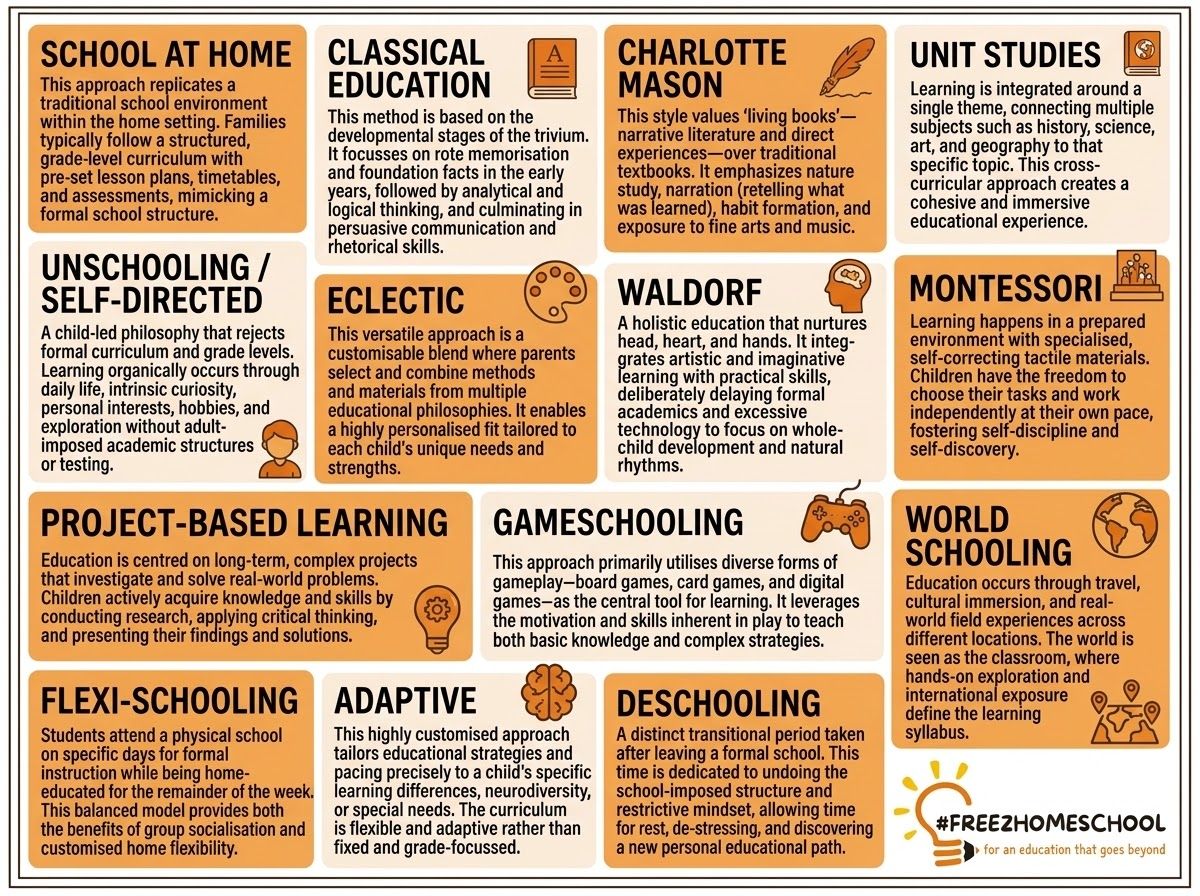
1. School-at-Home (Traditional)
The Concept:
School-at-home replicates a conventional classroom setting directly within the family home. Families typically purchase boxed, grade-level curricula complete with pre-set teacher guides, student workbooks, structured timetables, and formal assessment tests.
What It Looks Like:
A designated desk area, set school hours (e.g., 9:00 am to 3:00 pm), distinct subject blocks (maths, English, science, social studies), and regular marking or grading.
Best Suited For:
- Families transitioning temporarily from school who want continuity, planning to return to mainstream schooling.
- Parents who feel most confident adhering to an established, accredited syllabus, who prefer scripted teacher guides and standard grading.
- Students who thrive on routine, clear expectations, and formal milestone tracking.
- Families wanting high structure and predictability.
2. Classical Education
The Concept:
Rooted in Western antiquity and the medieval liberal arts, Classical education organises intellectual growth around the Trivium—a three-stage developmental model aligned with a child’s natural cognitive maturation.
The Three Stages:
- Grammar Stage (Primary years): Focuses on foundational knowledge, rote memorisation, phonics, mental arithmetic, and absorbing core facts.
- Logic/Dialectic Stage (Middle years): Channels the natural desire to question “why?” through formal logic, critical analysis, and examining cause and effect.
- Rhetoric Stage (Secondary years): Trains older students to articulate persuasive arguments, craft eloquent compositions, and engage in respectful debate.
What It Looks Like:
Heavy engagement with classical literature (“The Great Books”), chronological history studies across multi-year cycles, and often the study of Latin or classical Greek to build deep analytical and linguistic mastery.
Best Suited For:
- Children who love language, literature, debate, and history.
- Families who value rigorous analytical thinking, memorisation, and a systematic, chronologically grounded curriculum.
3. Charlotte Mason
The Concept:
Developed by 19th-century British educator Charlotte Mason, this philosophy is anchored in the premise that “Education is an atmosphere, a discipline, a life.” Mason viewed children as whole persons rather than empty vessels to be filled.
What It Looks Like:
- Living Books: Learning occurs through narrative, beautifully written literature rather than dry, fact-dense textbooks.
- Short, Focussed Lessons: Lessons range from 15 to 30 minutes to cultivate sharp habits of attention without mental fatigue.
- Narration: Children retell what they have heard or read in their own words, building comprehension and oral composition before formal written essays begin.
- Nature Study & Fine Arts: Daily outdoor time, dedicated nature journals, weekly picture study (art appreciation), and composer study.
Best Suited For:
- Nature lovers, avid readers, and families seeking a gentle, literature-rich education with short, high-focus lessons and minimal screen-based learning.
4. Unit Studies
The Concept:
Unit studies take a single, central theme and explore it comprehensively across almost every academic discipline simultaneously—integrating history, science, geography, literature, art, and maths.
What It Looks Like:
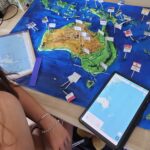
If a family chooses a unit on “The Great Barrier Reef,” the week might involve reading marine biology books (science), calculating navigational coordinates (maths), mapping coastal Queensland (geography), painting watercolour coral systems (visual arts), and writing a persuasive piece on ocean conservation (English).
Best Suited For:
- Families teaching multiple siblings of different ages together, allowing everyone to explore the same topic at their respective developmental levels.
- Visual and hands-on learners, and families who love deep dives into specific topics rather than fragmented, single-subject textbooks.
5. Unschooling (Self-Directed Learning)
The Concept:
Pioneered by educator John Holt, unschooling is a child-led, non-coercive philosophy. It rejects arbitrary grade levels, standardised testing, and fixed curricula, trusting that children possess an innate biological drive to learn when immersed in a rich, supportive environment.
What It Looks Like:
Learning happens organically as a natural by-product of living. A child fascinated by baking masters fractions, ratios, chemistry, and reading instructions. A passion for building video games leads into computer coding, narrative design, and graphic art. Parents act as facilitators, mentors, and resource providers rather than authority figures lecturing from a textbook.
Best Suited For:
- Best suited for highly motivated, curious, or autonomous children with distinct passions.
- Families who trust natural learning and wish to move completely away from institutional timelines, grades, and set curricula.
6. Eclectic (Relaxed)
The Concept:
The eclectic method is the most widely practised style among experienced home educators. Rather than committing exclusively to one doctrine, parents deliberately select and combine the best elements from various methods to design an entirely customised educational programme.
What It Looks Like:
A family might use a structured, mastery-based Singapore maths curriculum, follow a Charlotte Mason literature and nature study rhythm, explore science through hands-on unit studies, and allow unschooling principles to guide afternoons for personal hobbies and passions.
Best Suited For:
- Most real-world households, families with multiple children who have completely different learning styles.
- Parents who prefer the freedom to mix and match resources across different subjects.
7. Waldorf (Steiner)
The Concept:
Founded on the educational philosophy of Rudolf Steiner, Waldorf education focuses on holistic development—educating the “head, heart, and hands.” It aligns with seven-year developmental cycles, deeply valuing imagination, natural rhythms, and creative play.
What It Looks Like:
- Delayed Academics & Reduced Screens: Formal reading and technology are deliberately postponed in early childhood to protect imaginative play and motor development.
- Main Lesson Books: Instead of published textbooks, children create their own richly illustrated lesson journals containing narrations, sketches, and summaries.
- Handwork: Knitting, crocheting, woodworking, gardening, and music (such as recorder and singing) form core components of daily education.
Best Suited For:
- Artistic, imaginative, and sensory-driven children.
- Families who value natural rhythms, handcrafts, storytelling, and delaying formal academics and screen exposure in early childhood.
8. Montessori
The Concept:
Developed by Dr Maria Montessori, this approach is based on self-directed activity within a carefully “prepared environment,” hands-on tactile learning, and collaborative, multi-age peer interaction.
What It Looks Like:
Low, orderly shelves display purposeful activities and self-correcting manipulatives (e.g., golden beads for place value, wooden cylinder blocks, sandpaper letters). Children have long, uninterrupted three-hour work cycles where they freely choose their activities, work at their own pace, and master practical life skills (such as preparing food, pouring, cleaning, and gardening).
Best Suited For:
- Independent, tactile learners who thrive when moving freely in an orderly, prepared environment, using self-correcting manipulatives and building everyday practical life skills.
9. Project-Based Learning (PBL)
The Concept:
Project-Based Learning centres education on investigating and solving authentic, complex, real-world problems over an extended timeframe.
What It Looks Like:
Rather than completing abstract workbook exercises on ecology, a student might research how to establish a native bee hotel or design a household greywater recycling system. Throughout the project, they conduct field research, interview local experts, apply budget maths, draft design blueprints, and present their completed solution to a real audience.
Best Suited For:
Practical problem-solvers, inventors, and analytical thinkers who learn best by creating tangible outcomes, building, conducting investigations, and presenting real-world solutions.
10. Gameschooling
The Concept:
Gameschooling intentionally uses tabletop games, board games, card games, and digital gameplay as primary vehicles for academic acquisition and critical thinking.
What It Looks Like:
- Learning strategic resource management, supply and demand, and probability through modern board games.
- Mastering mental arithmetic and quick calculations with dynamic card games.
- Building spatial reasoning, geometry, logic, and teamwork through sandbox video games like Minecraft.
It harnesses the intrinsic motivation, low-stakes failure, and problem-solving inherent in games to make learning captivating and memorable.
Best Suited For:
- Playful, competitive, or reluctant learners.
- Neurodivergent children who shut down with traditional bookwork.
- Families who want to build critical thinking, collaboration, and strategy through board, tabletop, and digital games.
11. Worldschooling
The Concept:
Worldschooling treats the entire globe as the classroom. Education is grounded in physical travel, cultural immersion, and direct engagement with historical landmarks, diverse communities, and ecosystems.
What It Looks Like:
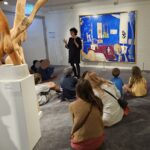
Whether travelling full-time in a caravan around Australia or journeying internationally, children learn history at archaeological ruins, practice languages in local markets, and study biodiversity directly in rainforests and oceans. For families who cannot travel full-time, “local worldschooling” involves constant immersion in local museums, nature reserves, and cultural festivals.
Best Suited For:
- Travelling families, digital nomads, and adventurous children who absorb knowledge most effectively through cultural immersion, geography, history, and first-hand life experience.
12. Flexi-Schooling
The Concept:
Flexi-schooling is a hybrid arrangement where a student is formally registered at a physical school and attends on specific agreed days (e.g., 2–3 days per week) while receiving home education for the remainder of the week.
What It Looks Like:
This model provides children with access to group classroom activities, school sporting teams, science labs, and social groups, while preserving the slower pace, customised instruction, and emotional rest of home education on alternate days. (Note: Availability depends on regional regulations and individual school principal discretion.)
Best Suited For:
- Families who want a balance of both worlds—benefiting from formal school facilities, specialised classes, and school social networks while retaining the flexibility and personalised pacing of home education.
13. Adaptive / Neurodivergent Home Education
The Concept:
A purpose-built approach tailored specifically to children with learning differences, neurodiversity (ADHD, Autism, Dyslexia, PDA), or chronic medical needs.
What It Looks Like:
Adaptive home education completely abandons standard grade milestones in favour of child-led pacing and sensory-friendly learning. It incorporates sensory swings, movement breaks, audiobooks, visual schedules, and strength-based learning. Parents can work closely alongside speech therapists, occupational therapists, and psychologists to ensure the home environment nurtures emotional regulation alongside academics.
Best Suited For:
- Children with ADHD, autism, dyslexia, sensory processing needs, or chronic health conditions, where custom pacing, low-stress environments, strengths-based learning, and sensory accommodations are vital.
14. Deschooling
The Concept:
Deschooling is not a permanent teaching method; rather, it is a transitional period of rest and mental decompression when a child leaves a conventional school setting before embarking on a formal home education path.
What It Looks Like:
During deschooling, all structured academic work, workbooks, and testing are intentionally set aside. The timeframe—often recommended at one month for every year spent in standard school, however this is not a set time—allows both parent and child to shed institutional anxiety, rebuild curiosity, reconnect as a family, and discover how the child naturally likes to learn.
Best Suited For:
- Children and parents newly transitioning out of a conventional school setting, particularly those recovering from burnout, school-induced anxiety, or rigid institutional expectations before selecting a permanent home education approach.
Looking Beyond: Lesser-Known Home Education Approaches
As you expand your horizons, you may also encounter several niche or lesser-known frameworks that families adapt around the world:
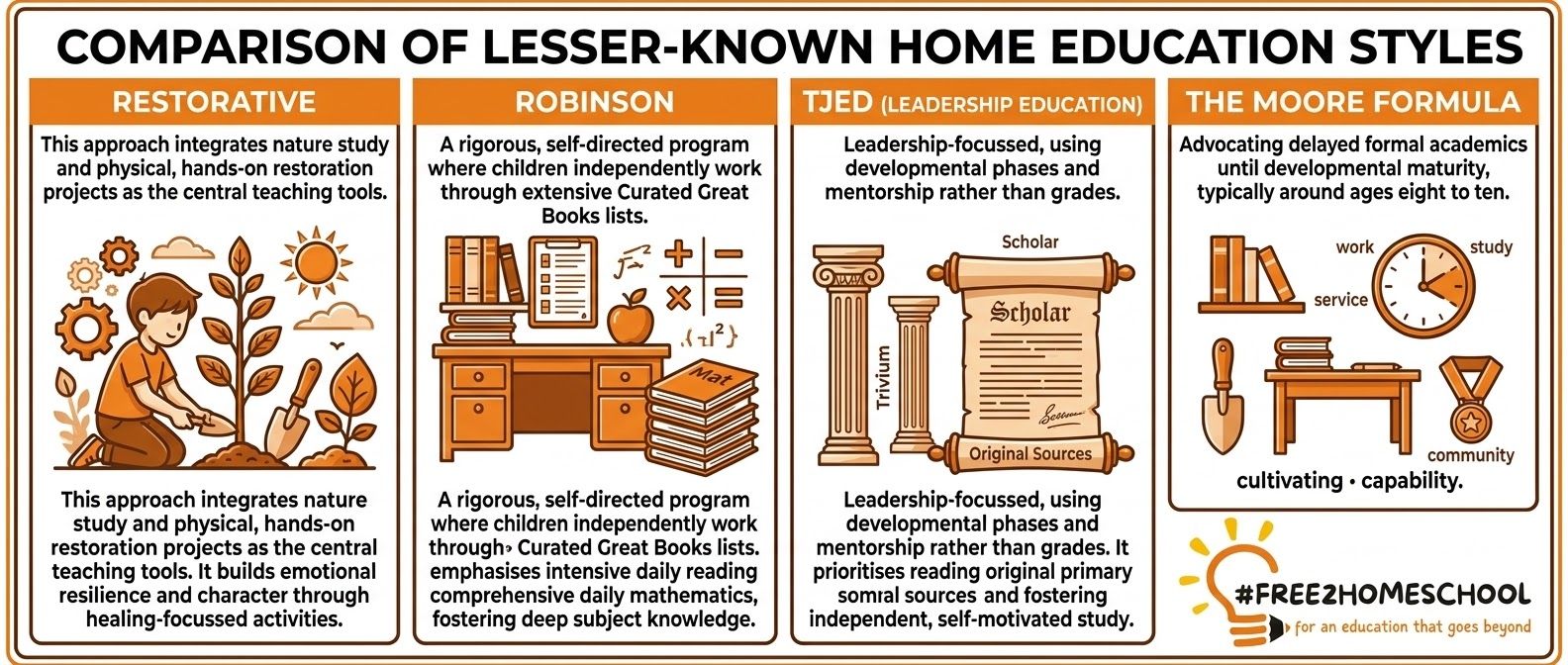
- Thomas Jefferson Education (TJEd / Leadership Education): Designed to foster statesmen, leaders, and independent thinkers. TJEd structures learning into four developmental phases (Core, Love of Learning, Scholar, and Depth), prioritising classic literature, original historical sources, and parent mentorship (“inspire, don’t require”) over standardised testing.
- The Moore Formula: Founded by Dr Raymond and Dorothy Moore, this model advocates for delaying formal desk work until ages 8 to 10. Daily life is balanced across three equal pillars: academic study suited to individual maturity, meaningful practical work (chores, trade skills, gardening), and regular community service.
- The Robinson Curriculum: A rigorous, self-teaching model focused on academic independence. Children spend dedicated hours daily working through Saxon maths, completing original writing, and independently reading from a list of over 250 classic historical texts without screens or distractions.
- Restorative (Ortho-Restorative) Education: A nature-rich, therapeutic approach designed for children recovering from institutional burnout, bullying, or trauma. It emphasises outdoor sensory grounding, animal care, handicrafts, and calm rhythms to restore emotional wellbeing before reintroducing academic challenges.
Embracing Your Family’s Unique Rhythm
There is no “correct” way to home educate. What works wonders for an active seven-year-old might look completely different from what supports an independent teenager. The beauty of this path lies in its freedom: you have the agency to begin with one philosophy, borrow elements from another, and evolve your style as your children grow.
A Gentle Reminder…
You Are Not Bound to a Label
As you read through these diverse methods, it is natural to feel drawn to elements of several, or overwhelmed by trying to pick the “right” one.
The greatest gift of home education is not the curriculum you choose, but the freedom to tailor learning to the real, unique human beings living under your roof. An educational philosophy should be a servant to your household, never a master.
If a method clashes with your family’s deepest beliefs, if a routine drains the joy from your days, or if a curriculum does not honour how your child’s mind works, give yourself unconditional permission to pivot. You are not running a miniature institution; you are cultivating a culture of learning within your home. Take the parts that breathe life into your days, leave behind the parts that do not, and trust that the best educational style is simply the one where your child thrives.
What to take from this to empower yourself
- Curriculum Serves the Family, Not the Other Way Around: Remember that an educational philosophy is a toolkit, not a contract. If a math program causes daily tears or a literature list feels like a chore rather than an inspiration, parents have full permission to discard or alter it without feeling like they have “failed” the method.
- Beware of “Method Dogma” and Homeschool Idealism: It is easy to fall in love with the romantic ideal of a philosophy (e.g., the idyllic outdoor sketches of Charlotte Mason or the rigorous intellect of Classical) only to find that your child’s temperament, neurodivergence, or high-energy personality clashes with it. Embracing reality over romanticised ideals protects the parent-child relationship.
- Education Moves in Seasons, Not Permanence: What fits an eight-year-old discovering a passion for wildlife may look nothing like what that same child needs at fourteen preparing for tertiary entrance, vocational pathways, or independent enterprise. You do not need to choose a style for your child’s entire school career—only choose what serves the current season.
- The Danger of Re-Creating the Classroom at Home: Many parents default to School-at-Home simply because it is the only model personally experienced. Home education offers the freedom to dismantle arbitrary expectations—like sitting at a desk for six hours or separating knowledge into disconnected 45-minute blocks—in favour of authentic, integrated living.
- Child-Led Alignment Over External Validation: Comparison is the fastest route to burnout. Trying to match what works for an online influencer, a support group peer, or an extended family member often leads to friction. The best approach is always the one that fosters genuine curiosity, emotional safety, and character growth in their specific home.
- “Take the Best and Leave the Rest”: Adopt an unashamedly eclectic mindset. You can easily combine the living books of Charlotte Mason with the self-paced independence of Robinson math and the hands-on project work of unit studies, tailoring the blend entirely to your family values and rhythm.